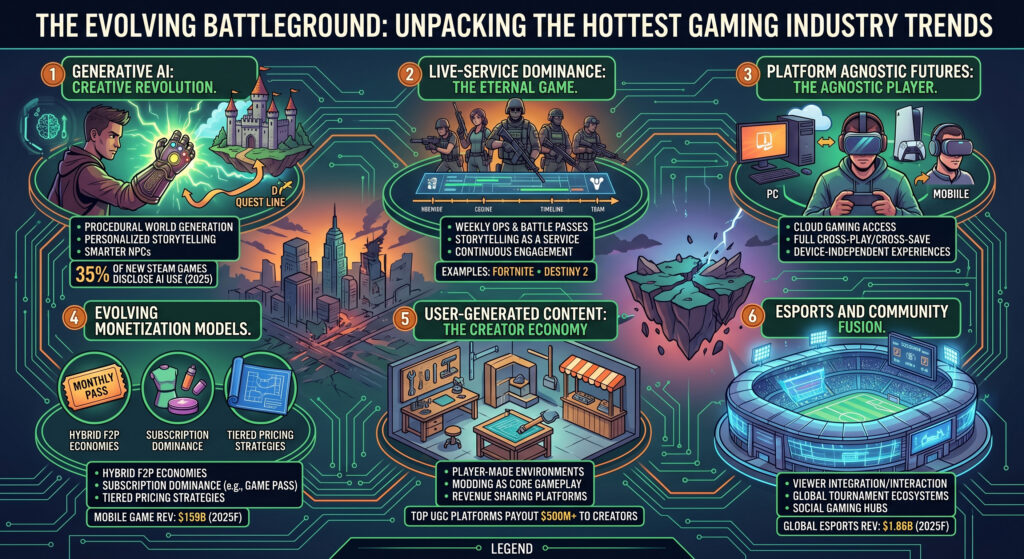
The Evolving Battleground: Unpacking the Hottest Gaming Industry Trends
The gaming industry, a powerhouse of innovation and entertainment, continues its relentless expansion, captivating billions worldwide. What was once a niche hobby has transformed into a cultural phenomenon, a multi-billion-dollar global enterprise that consistently pushes the boundaries of technology, narrative, and community. From the groundbreaking advancements in graphics and processing power to the emergence of entirely new business models and competitive arenas, the landscape of video games is in a constant state of flux. Keeping abreast of the latest gaming news and developments isn’t just for enthusiasts; it’s essential for anyone seeking to understand the future of entertainment, technology, and social interaction. This article delves deep into the most significant trends currently shaping the gaming industry, offering a comprehensive look at where we’ve been and where we’re headed.
The Rise of Immersive Experiences: VR, AR, and Beyond
Immersion has always been a core tenet of good game design, but recent technological leaps are taking it to unprecedented levels. Virtual Reality (VR) and Augmented Reality (AR) are no longer futuristic concepts; they are tangible realities beginning to redefine how players interact with digital worlds.
Virtual Reality’s Expanding Horizons
VR gaming, while still in its nascent stages compared to traditional gaming, is rapidly maturing. Headsets like Meta Quest, PlayStation VR2, and Valve Index offer increasingly sophisticated experiences, characterized by higher resolutions, wider fields of view, and more intuitive tracking. Games such as Half-Life: Alyx have showcased the narrative and gameplay potential of the medium, delivering experiences simply impossible on a flat screen. Developers are continually refining motion controls, haptic feedback, and spatial audio to create more convincing presence, pulling players deeper into virtual environments. The challenges of high hardware costs, potential motion sickness, and the need for dedicated play spaces are slowly being addressed through more affordable standalone headsets and innovative design. As the technology becomes more accessible and comfortable, VR is poised to carve out a significant segment of the gaming market, offering truly unparalleled levels of immersion.
Augmented Reality’s Subtle Integration
Unlike VR, which transports users to entirely new worlds, AR overlays digital information onto the real world. Its integration into gaming has been more subtle but equally impactful. Mobile AR games like Pokémon GO demonstrated the immense potential for blending digital play with physical exploration, creating unique social experiences. Beyond mobile, AR is finding its way into specialized hardware and potentially future smart glasses, offering a continuous layer of interactive digital content in our daily lives. While full-fledged AR gaming spectacles are still some years away from mass adoption, the underlying technology continues to evolve, promising a future where our reality is seamlessly augmented with interactive gameplay elements, from virtual pets walking alongside us to interactive puzzles superimposed on city streets.
The Metaverse Concept: A New Digital Frontier
Perhaps the most ambitious vision for immersive experiences is the metaverse – a persistent, interconnected network of 3D virtual worlds where users can interact with each other, digital objects, and AI avatars. While the term is often overused, platforms like Roblox, Fortnite, and Decentraland offer early glimpses of this concept. These platforms aren’t just games; they are social spaces, creative tools, and nascent economies. The metaverse promises a future where gaming, social media, work, and commerce blur, allowing users to move seamlessly between experiences while retaining their digital identities and assets. The development of robust interoperability standards, secure digital ownership, and powerful rendering technologies will be crucial for the metaverse to realize its full potential, transforming how we live, work, and play in the digital realm.
Esports: From Niche Hobby to Global Phenomenon
The transformation of competitive gaming into a global spectator sport is one of the most compelling narratives in the modern entertainment industry. What began in basements and LAN parties has erupted into a professional ecosystem with millions of fans, dedicated arenas, and multi-million-dollar prize pools.
Professionalization and Mainstream Acceptance
Esports has shed its “gaming nerd” stereotype to become a legitimate professional sport. Major tournaments for titles like League of Legends, Dota 2, CS:GO, and Valorant attract viewership numbers comparable to traditional sports championships, filling stadiums and drawing massive online audiences. Professional players are celebrated athletes, undergoing rigorous training regimens, supported by coaches, analysts, and sponsors. Universities are now offering esports scholarships, and major media outlets routinely cover gaming news related to competitive play. This mainstream acceptance is fueled by the inherent excitement of high-stakes competition, combined with the accessibility of watching top-tier gameplay from anywhere in the world.
The Business of Competitive Gaming
The business infrastructure supporting esports is incredibly sophisticated. It includes team organizations, league operators, broadcasting networks, and event management companies. Sponsorship deals with non-endemic brands (like Mercedes-Benz, Red Bull, and Mastercard) are skyrocketing, signaling confidence in esports’ marketing power. Media rights for league broadcasts are becoming increasingly valuable, and teams are building their own brands through merchandise, content creation, and fan engagement. The economic model is robust, driven by a combination of advertising, sponsorships, ticket sales, in-game purchases, and crowdfunding initiatives, demonstrating a sustainable pathway for continued growth.
Fan Engagement and Community Building
At the heart of esports’ success is its passionate global community. Streaming platforms like Twitch and YouTube Gaming allow fans to connect directly with professional players and content creators, offering a level of intimacy rarely seen in traditional sports. Interactive features, chat communities, and dedicated social media channels foster a strong sense of belonging and camaraderie. The ability for fans to participate indirectly through fantasy leagues, betting, and in-game predictions further deepens their investment. This active engagement creates a vibrant ecosystem where fans are not just spectators but integral parts of the evolving esports narrative.
Cloud Gaming and Accessibility: Gaming Anywhere, Anytime
The dream of playing high-fidelity video games without expensive hardware is rapidly becoming a reality, thanks to the advancements in cloud gaming. This trend promises to democratize access and fundamentally alter how consumers acquire and experience games.
The Promise of Streaming Services
Cloud gaming services, like NVIDIA GeForce NOW, Xbox Cloud Gaming, and Amazon Luna, leverage remote servers to render and stream games directly to a user’s device. This eliminates the need for powerful local hardware, opening up high-end gaming to a vast array of devices, from smart TVs and low-spec laptops to tablets and smartphones. While early pioneers like Google Stadia faced significant hurdles, the underlying technology continues to improve, offering lower latency and higher fidelity streams. Subscription models are becoming standard, offering libraries of games akin to Netflix for movies, providing immense value and convenience to players.
Democratizing Access to High-End Gaming
The most significant impact of cloud gaming is its potential to broaden the gaming audience. By removing the barrier of entry posed by expensive consoles or gaming PCs, millions more can access the latest titles. This is particularly transformative in regions where economic factors make traditional gaming hardware prohibitive. Cloud gaming enables instant play without lengthy downloads or installations, making gaming a more spontaneous and frictionless activity. This accessibility is a game-changer, potentially unlocking new demographics and geographic markets for the industry.
Network Infrastructure and Future Challenges
Despite its promise, cloud gaming faces challenges, primarily related to network infrastructure. A stable, high-bandwidth, low-latency internet connection is crucial for a seamless experience. As 5G networks become more ubiquitous and fiber optics expand globally, these issues will diminish, but they remain significant hurdles in many parts of the world. Data center proximity, server capacity, and efficient compression algorithms are also critical for delivering a consistent, high-quality stream. Overcoming these technical challenges will be key to cloud gaming’s eventual mainstream dominance.
The Influence of AI and Machine Learning in Game Development
Artificial Intelligence (AI) and Machine Learning (ML) are not just buzzwords; they are transformative technologies revolutionizing nearly every aspect of game development, from character behavior to content creation.
Enhancing Gameplay and NPC Intelligence
Modern AI enables Non-Player Characters (NPCs) to exhibit far more realistic and adaptive behaviors. No longer confined to simple pre-scripted routines, AI-driven NPCs can learn from player actions, react dynamically to environmental changes, and offer more complex challenges. This leads to richer, more emergent gameplay experiences, where every playthrough feels unique. AI is also used to create dynamic difficulty scaling, ensuring games remain engaging for players of all skill levels, and for generating realistic crowd simulations, traffic patterns, and ecosystem behaviors in open-world titles, bringing virtual worlds to life.
Procedural Content Generation
One of the most exciting applications of AI is in procedural content generation (PCG). Instead of painstakingly handcrafting every environment, object, and quest, developers can use AI algorithms to generate vast, intricate worlds, levels, and items on the fly. This significantly reduces development time and costs, particularly for large-scale open-world games, and allows for infinite replayability, as seen in games like No Man’s Sky. PCG can also be used to create personalized content based on player preferences, ensuring a fresh experience every time. This not only empowers smaller indie studios but also frees up larger teams to focus on core design and narrative elements.
Player Analytics and Personalization
Machine learning excels at processing vast amounts of player data. Game developers use ML to analyze player behavior, identify pain points, understand engagement patterns, and predict future trends. This data-driven approach informs design decisions, helps balance gameplay, and optimize monetization strategies. Beyond development, ML is crucial for personalizing the player experience, from recommending new games or content to tailoring in-game advertisements and dynamically adjusting game elements to match individual player styles. This level of personalization can significantly enhance player retention and satisfaction, ensuring that each player’s journey is unique and engaging.
Blockchain, NFTs, and Play-to-Earn Models
The advent of blockchain technology has introduced a paradigm shift in how digital assets are owned, traded, and valued, giving rise to new economic models within the gaming sphere.
The Web3 Revolution in Gaming
Blockchain-integrated games, often referred to as Web3 games, promise to decentralize control and empower players with true ownership of their in-game assets. This contrasts sharply with traditional games where players ‘license’ digital items from the publisher, who retains ultimate control. Web3 aims to shift power from centralized developers to the community, fostering player-owned economies and governance models through decentralized autonomous organizations (DAOs).
NFTs: Digital Collectibles and In-Game Assets
Non-Fungible Tokens (NFTs) are the core technology enabling true digital ownership. An NFT represents a unique digital item (e.g., a rare skin, a virtual plot of land, a unique character) whose ownership is recorded on a blockchain. This provides verifiable scarcity, provenance, and the ability to freely trade these assets on open marketplaces, even outside the game’s ecosystem. While the NFT market has seen volatility and skepticism, its potential for creating persistent digital identities and interoperable assets across different virtual worlds remains a significant draw for innovators in the video games space.
Play-to-Earn (P2E) and Player-Owned Economies
The Play-to-Earn (P2E) model allows players to earn cryptocurrencies or NFTs through gameplay, which can then be sold for real-world value. Games like Axie Infinity pioneered this concept, demonstrating how players in developing economies could earn a living wage by playing. This model incentivizes engagement and creates a robust in-game economy driven by player activity. However, P2E also faces challenges regarding sustainability, economic balance, and potential for speculation rather than genuine enjoyment. The industry is still exploring how to integrate P2E responsibly, focusing on creating fun games first, with meaningful ownership and earning potential as secondary benefits.
Indie Games and Niche Markets: A Creative Renaissance
While AAA blockbusters often dominate the headlines, the independent gaming scene continues to be a vibrant crucible of creativity, pushing boundaries and catering to diverse tastes.
The Power of Independent Developers
Independent (indie) developers, unencumbered by the corporate structures and commercial pressures of large studios, have the freedom to experiment with unique mechanics, unconventional narratives, and artistic styles. Digital distribution platforms like Steam, itch.io, and console eShops have democratized access to market, allowing small teams to reach global audiences directly. This has led to an explosion of innovative and critically acclaimed titles that often challenge conventions and explore themes rarely touched upon by mainstream games, consistently generating exciting gaming news within the creative community.
Embracing Diversity and Niche Appeal
Indie games frequently excel at targeting niche audiences and celebrating diversity. From narrative-driven experiences that tackle complex social issues to highly specialized simulator games or experimental art games, the indie scene caters to a vast spectrum of player preferences. This focus on specific tastes allows for deeper engagement and fosters incredibly loyal communities. Furthermore, many indie developers prioritize accessibility, implementing features that make their games enjoyable for players with disabilities, leading to more inclusive gaming experiences for everyone.
Community-Driven Development
Many indie studios thrive on close interaction with their player communities. Early Access programs, crowdfunding campaigns (e.g., Kickstarter), and active Discord servers allow players to provide direct feedback, influence development decisions, and feel a sense of ownership over the games they love. This collaborative approach fosters transparency and builds strong relationships between developers and their audience, creating a virtuous cycle of feedback and improvement. It also allows developers to iterate quickly and adapt to player needs, ensuring the final product resonates deeply with its intended audience.
Conclusion: The Dynamic Future of Gaming
The gaming industry is a testament to relentless innovation and boundless creativity. From the cutting-edge immersion offered by VR and AR to the global spectacle of esports, and from the democratic access of cloud gaming to the disruptive potential of Web3, the landscape is constantly shifting. AI and machine learning are revolutionizing development processes, while the indie scene continues to be a vibrant wellspring of unique experiences. The intersection of these trends promises a future where video games are more accessible, personalized, interactive, and socially integrated than ever before. As technology continues its rapid advancement, staying informed through consistent gaming news will be crucial to understanding the profound impact this industry will have on entertainment, culture, and beyond. The future of gaming isn’t just about playing; it’s about building new worlds, fostering communities, and redefining the very boundaries of digital interaction.
Leave a Reply